
A Deep Dive Look at the Pros and Cons, Housing Options, Features, Costs, and Social Aspects of Moving to a 55+ Community
If you are downsizing and researching 55+ communities, you’re probably already past casual curiosity about senior living real estate. You may be comparing listings, looking at maps, or imagining what daily life would feel like in a community designed around adults in a similar stage of life. This guide is meant to slow the process down just enough to help you see where a for-sale 55+ community truly supports how you want to live, and where it might quietly work against you.
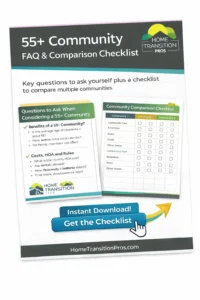
Throughout, you will find clear pros and cons of the 55+ lifestyle, as well as practical details. Our deep dive covers downsizing into for-sale 55+ communities only. It does not address rentals, assisted living, or care-based housing. At the end you’ll find access to a free comprehensive 55+ community FAQ with comparison checklist; to use to keep track of your insights while shopping 55+ senior living communities.
What makes the “is a 55+ community right for me” decision difficult is not a lack of information. It is that the same feature can feel comforting to one person and constraining to another. So how to decide if you and a 55+ community are a good match? An age specific community sometimes suits people who appreciate structure, predictability, shared standards, and lower maintenance. It may feel less comfortable for those who strongly value flexibility, mixed-age environments, or complete autonomy. Personality matters. Timing matters. What feels restrictive now may feel reassuring later, and the reverse can also be true.
Pros and Cons of Buying in a 55+ Community
People search for pros and cons because they want clarity without pressure. Downsizing into an active adult 55+ community comes with lots of things to consider. The following is a very high-level look to get a base understanding of the topics that come up the most often when seniors are discussing downsizing to a 55+ community.
Common Benefits Buyers Appreciate
- Homes are often designed for easier movement and long-term comfort
- Exterior maintenance may be handled for you
- Amenities reflect adult lifestyles rather than family-oriented needs
- Neighborhoods tend to be quieter and more predictable
- Social opportunities exist without requiring participation
Common Tradeoffs to Weigh Carefully
- HOA fees add ongoing monthly costs
- Rules limit certain types of flexibility
- Community culture may or may not match your personality
- Resale markets are narrower
- Locations are sometimes more limited
Keep these points in mind as we dig deeper into all the different community options and how they might match your intended lifestyle. Now let’s take a look at the different types of communities you might consider.
What a 55+ Community Really Is...and Isn't
A 55+ community, also called an active adult community, and sometimes senior living, is an age-restricted residential development where at least one household member must meet the minimum age requirement. These communities are permitted under federal housing law and are designed to support independent living.
According to the U.S. Department of Housing and Urban Development, age-restricted housing allows communities to tailor design, amenities, and governance to older adults while still functioning as standard homeownership environments.
What these communities are not is just as important:
- They are not assisted living
- They do not provide medical or personal care
- They do not remove independence or personal responsibility
Residents own their homes, manage their daily lives, and participate in shared governance much like any HOA-based neighborhood.
Pause and consider:
If independence means autonomy with structure, this model often works well. If independence means no shared rules at all, it may feel restrictive over time.
Types of 55+ Communities and How They Feel Day to Day
One of the most common missteps buyers make is assuming that all 55+ communities offer a similar lifestyle. In practice, the structure and scale of the community shape daily life far more than the age requirement itself.

High-Rise and Mid-Rise 55+ Condominium Buildings
Often found in urban areas or close-in suburbs, these communities prioritize convenience and security. Controlled entry, elevators, interior corridors, and covered parking are common. Some buildings offer concierge services or staffed front desks.
These communities often appeal to buyers who value walkability, cultural access, and a lock-and-leave lifestyle. The tradeoff is typically higher monthly fees and less private outdoor space.
Reflection point:
If downsizing means you’re looking for ease of living, fewer decisions, and less upkeep, this can feel freeing. If ease means giving up space or privacy you still enjoy, it can feel like too much change.
Village-Style and Master-Planned 55+ Communities
These are larger, campus-like developments with multiple housing styles and robust amenities. Clubhouses, pools, fitness centers, walking trails, and organized activities are often central features.
For some buyers, this feels energizing and socially rich. For others, it can feel busy or overly programmed. Size alone does not determine quality, but it does influence pace and atmosphere.
Townhome, Villa, and Duplex 55+ Communities
These communities offer a middle ground between condos and single-family homes. Residents often have private entrances and shared exterior maintenance within smaller, quieter neighborhoods.
They tend to appeal to buyers who want privacy without yard work and who are easing into downsizing rather than making a dramatic shift.
Boutique or Small-Scale 55+ Developments
Smaller communities with fewer homes and limited amenities often emphasize consistency and familiarity over activity calendars. These communities can feel stable and neighborly, especially for buyers uninterested in organized programming. These jewel box communities are a bit harder to find, but a great option for downsizers looking for a quaint setting, or intimate neighborhood feel.
Costs, Fees, and What to Compare Before You Buy
Purchase price alone rarely tells the full financial story in a 55+ community. Senior living communities offer a host of options. Some can impact overall pricing greatly, so look at the complete cost picture carefully. Ongoing costs shape long-term comfort and satisfaction. At the end of our guide you can download our free 55+ community comparison checklist.
HOA and Community Association Fees
These often cover landscaping, exterior maintenance, insurance for shared structures, snow removal, trash service, and professional management. Fees vary widely, and higher fees are not automatically negative if services align with your priorities.
Amenity and Service-Related Costs
Some communities charge separate fees for fitness centers, pools, golf courses, transportation, or organized programs. It is essential to understand what is included, optional, or mandatory.
Special Assessments
Occasional one-time charges may fund major repairs, infrastructure improvements, or amenity upgrades. Reviewing reserve funding and assessment history is as important as reviewing current fees.
Property Taxes and Transfer Fees
Taxes vary by location and home value. Some communities charge initiation, buy-in, or transfer fees at purchase or resale.
The Urban Institute emphasizes that long-term housing affordability depends on predictable costs, not just purchase price.
Pause and consider:
Does paying for convenience feel like relief, or like giving something up? Downsizing into some communities can be more expensive than your original home, or a trade off between home values and fees for freeing up your time for leisure. Take a good look at your true costs and decide what kind of 55+ community is the best fit for your downsizing plan.
Amenities are often heavily marketed, but their value depends entirely on how you live. Many 55+ communities offer clubhouses, fitness rooms, pools, hobby spaces, and organized clubs.

When looking at amenity packages don’t let overwhelming choices or flashy presentation affect your decisions. Before you visit, make a list of what you like to do, or hope to have access to, then focus on those things. While touring, think about what you’ll actually participate in, how physically active you’d like to be, and if your specific amenity needs would be met. Also don’t let a great amenity package steer you away from another community that actually has better homes for your lifestyle, with a la carte amenities nearby.
The National Council on Aging notes that social engagement supports well-being when it aligns with personal preferences. Too much structure can feel as isolating as too little.
Reflection point:
Ask yourself whether you enjoy joining groups, or whether you prefer relationships that develop quietly and naturally. And will you really use the pickleball courts and pool our are they costly nice-to-haves when you’re a cozy by the fireplace or watch the birds from the screened in porch kind of person. But, if you’re a do-er and very active socially, put amenities and clubs high on the list.
Things You Can't Change
There are so many touch points in making sure 55+ real estate is a good fit for your lifestyle and future needs. Locations vary widely as do rules and regulations. You’ll want in-depth information on restriction, resale opportunities, and a host of other legal and market related details to future-proof your decision. considerations.
Location, Transportation, and Surrounding Area Factors
A well-designed community can still be the wrong choice if its location does not support your daily life. Does your downsizing plan mean you’ll be reducing to just one car, or hoped not to use a car at all?
Consider whether a car is required, how close healthcare and everyday services are, and what the surrounding density feels like. Some buyers prefer privacy and separation, while others want proximity to restaurants, culture, and family.
Rules, Restrictions, and Living With Shared Governance
Every 55+ community operates under governing documents that shape daily life. These often address pets, guest access, rentals, home modifications, and amenity use.
Rules provide predictability, but they only feel comfortable when they align with your expectations.
The Centers for Disease Control and Prevention highlights that feeling comfortable and in control of one’s environment supports long-term satisfaction.
Resale, Long-Term Flexibility, and Future Planning
55+ communities can resell well, especially in areas with strong demand, but the buyer pool is more specific. Age restrictions, HOA rules, and community reputation all affect future flexibility.
Understanding how easily you could sell if your plans change is an important part of the decision.
Pause and consider:
Do you have enough information to make a good decision? Have you spent time with a seasoned senior-focused Realtor to understand the senior real estate market and communities you’re considering?
Talk with a Senior-Focused Realtor or Senior Move Manager Today

No article can replace local insight. Rules, costs, culture, and resale dynamics vary significantly by area and by community. You really need to lean on someone with an intimate understanding of the pros and cons of downsizing to the 55+ communities in your area.
A senior-focused Realtor will have toured and sold many of the communities you hope to better understand. They’ll share insights and information very hard to obtain on your own. They can help you compare communities, interpret governing documents, understand long-term costs, and identify options that truly match your priorities. Find senior downsizing and 55+ community help near you.
Downsizing to a 55+ Community Lifestyle FAQ
Here are a few of the top 55+ lifestyle questions to ask your senior-focused agent, the community sales team, and yourself as you navigate the many options available in senior living communities. Our Comprehensive Free Community FAQ with downloadable Comparison Checklist is available following this section.
Community Feel, Culture, and Big-Picture Fit in Senior and 55+ Communities
What is the average age of residents, and does the community feel quiet and low-key or very social and active?
In senior communities, including many 55+ and independent living communities, age requirements create a shared starting point, but they do not define daily life. Some age-restricted communities attract residents who are newly retired and enjoy staying active, while others naturally feel calmer and more routine-focused. Neither dynamic is inherently better. What matters is whether the overall pace fits how you want your days to feel now.
Two 55+ communities can look nearly identical online and feel completely different once you spend time there. Paying attention to how residents use shared spaces, how often neighbors stop to talk, and whether the atmosphere feels energizing or subdued often reveals more than any brochure.
Will I realistically be able to make friends here, and do residents actually use the clubhouse and shared spaces?
Many buyers assume that moving into a senior or independent living community automatically leads to connection, but that depends on how people engage with the environment. In some 55+ communities, the clubhouse is a natural gathering place where conversations happen without planning. In others, shared spaces remain quiet unless there is a scheduled activity.
What matters most is not whether amenities exist, but whether they support interaction in a way that feels comfortable to you. Watching how residents greet one another or linger in common areas can offer a clearer picture of the community’s social rhythm.
How are new residents welcomed, and is there a process to help people get connected socially?
Some senior communities within 55+ developments make a genuine effort to welcome new residents through informal introductions, small gatherings, or resident-led outreach. Others take a more independent approach and expect people to find their own connections over time.
If community matters to you, it helps to understand how much support exists during the transition. Early experiences often shape whether an age-restricted or independent living community feels familiar and comfortable, or distant, long after move-in day.
Amenities, Activities, and Social Life in Senior and 55+ Communities
How active is the social calendar, and which events are actually well attended?
Most senior communities publish a full calendar of activities, but the real measure is participation. In some 55+ communities, events are well attended and become part of daily life. In others, only a small group shows up consistently, even when options look plentiful on paper.
What matters is whether the activities reflect how residents actually want to spend their time. A shorter list of well-loved gatherings often creates a stronger sense of connection than a packed calendar that feels optional or underused.
How are activities communicated, and does participation feel optional or expected?
In independent living communities, communication styles vary widely. Some rely on regular emails, apps, or printed schedules, while others depend on informal word of mouth. The tone of that communication matters as much as the method.
In the best-fit senior communities, activities feel available rather than obligatory. If participation ever feels expected instead of inviting, that subtle pressure can change how comfortable the community feels over time.
Is there an activities director or staff member responsible for planning events?
Many 55+ communities have a dedicated person coordinating activities, which often leads to better organization and consistency. This can be reassuring if you value structure or enjoy trying new things without having to plan them yourself.
Other senior communities rely on resident-led efforts, which can feel more organic but also less predictable. The right approach depends on whether you prefer structure or spontaneity in your social life.
Guests, Family, and Everyday Flexibility in Age-Restricted Communities
Are there restrictions on how long younger visitors or family members can stay?
In most age-restricted and 55+ communities, family visits are allowed, but longer stays are usually limited. These limits exist to preserve the community’s status, but they also shape how flexible daily life feels.
Occasional short visits may fit easily within the rules, while extended stays by adult children or grandchildren can feel more constrained. Thinking through how often family visits now, and how that might change, can help clarify whether the limits would feel manageable.
Are guests allowed to use amenities such as the pool or clubhouse?
Guest access to amenities varies widely across senior and independent living communities. Some allow limited use when accompanied by a resident, while others reserve amenities almost entirely for residents.
This difference can affect how welcoming visits feel. Two communities with similar amenities can offer very different experiences depending on how guest access is handled in practice.
If family visits frequently, would the community’s rules feel supportive or limiting over time?
Rules that seem reasonable in theory can feel different once they apply to everyday life. If family visits are a regular part of your routine, even small restrictions can start to feel more significant.
Imagining real scenarios, rather than ideal ones, often reveals whether a community’s flexibility aligns with how you actually live.
Homes, Maintenance, and Living Comfort in Senior Communities
What routine maintenance is included, and how does that affect daily life?
In senior and 55+ communities, maintenance coverage ranges from minimal to nearly comprehensive. Some handle only shared spaces, while others take care of most exterior responsibilities.
The key question is how much responsibility you want to keep. Reduced maintenance can feel freeing, but only when it truly matches what you expect to hand off.
Does the home include any interior or exterior maintenance services?
Interior maintenance is often the homeowner’s responsibility, even in independent living communities where exterior care is included. This distinction is easy to miss but becomes important over time. Knowing where that line is drawn helps avoid frustration and makes it easier to plan for future upkeep.
Can homes be modified easily if accessibility needs change over time?
Some age-restricted and senior communities allow flexibility for modifications, while others limit changes to maintain a consistent appearance. These policies can affect how long the home continues to work for you. Even if changes are not needed now, understanding what is possible later can bring peace of mind.
Rules That Can Impact Lifestyle
What community rules most affect daily life?
Rules around parking, guests, noise, and exterior changes shape the lived experience in age-restricted communities more than many buyers expect.
The real question is whether those rules feel reasonable and compatible with how you prefer to live.
Are rentals allowed, and how might restrictions affect flexibility later on?
Rental rules vary widely across senior and 55+ communities and can change over time. Even if renting is not part of your current plan, restrictions can limit options if circumstances shift.
This is often less about investment goals and more about personal flexibility.
Are there restrictions on home modifications or landscaping?
Rules around modifications are usually meant to maintain consistency, but they can limit personal expression. How much that matters depends on your priorities.
Understanding these boundaries early helps avoid frustration later.
Favorite Downsizing Guides and Tools
Our senior move and senior downsizing resources are free and do not require an optin or email address. We’re here to help, and hope you find these guides beneficial. Please reach out if there is something we can do to make your downsizing journey less stressful or more productive. Best to you from the entire Home Transitions Pros Welcome Center Team.
Downsizing Planning Guide
Our free senior move and downsizing planning guide is designed to walk you through the month-by-month flow of the most important tasks related to your downsizing adventure.
See Our Guide
55+ Communities –
Pros, Cons & Lifestyle Fit
Is a 55+ community the right fit for your lifestyle? Our guide is all about active adult communities and the most important lifestyle adjacent FAQs.
See Our Guide
55+ Communities –
Comprehensive FAQ
We take the FAQ even further. Once you’ve read our Pros and Cons guide, move on to this complete deep dive on all the questions you’ll need to consider when looking into living in a 55+ lifestyle community. See Our Guide
55+ Comparison Checklist
There are do many things to consider. Once you’re actually visiting and calling communities, you want this checklist to keep track of the ins and outs of each property. Use it as a guide on calls, or visits so you don’t forget to ask the most important questions.
See Our Guide
Amenities, Activities, and Social Life Expectations